
The Sympathy Die
Sheldon's idea, from our crazy-gadgets round: an electronic die that notices you have rolled badly three times running and, one time in three, quietly gives you a six. Rigged, but kind.
1. Make the board
Prompt
Make me an electronic die: seven red LED pips in the usual pattern, a ROLL button, a coin cell, and a small chip that can be programmed to be kind.
Why it is written this way
A die face only ever lights four groups of pips: the centre, one diagonal pair, the other diagonal pair and the middle pair. So the seven LEDs need just four pins of an ATtiny85, each LED with its own 220 Ω resistor, plus one pin for the ROLL button. The board is a white die face with the pips where a real die has them, a CR2032 on the back, a slide switch and a six-pin header to program it.
Output
create_project · add_component ×24 · assign_net_by_name · move_component · auto_route · add_zone · run_checks · share_board
No errors.
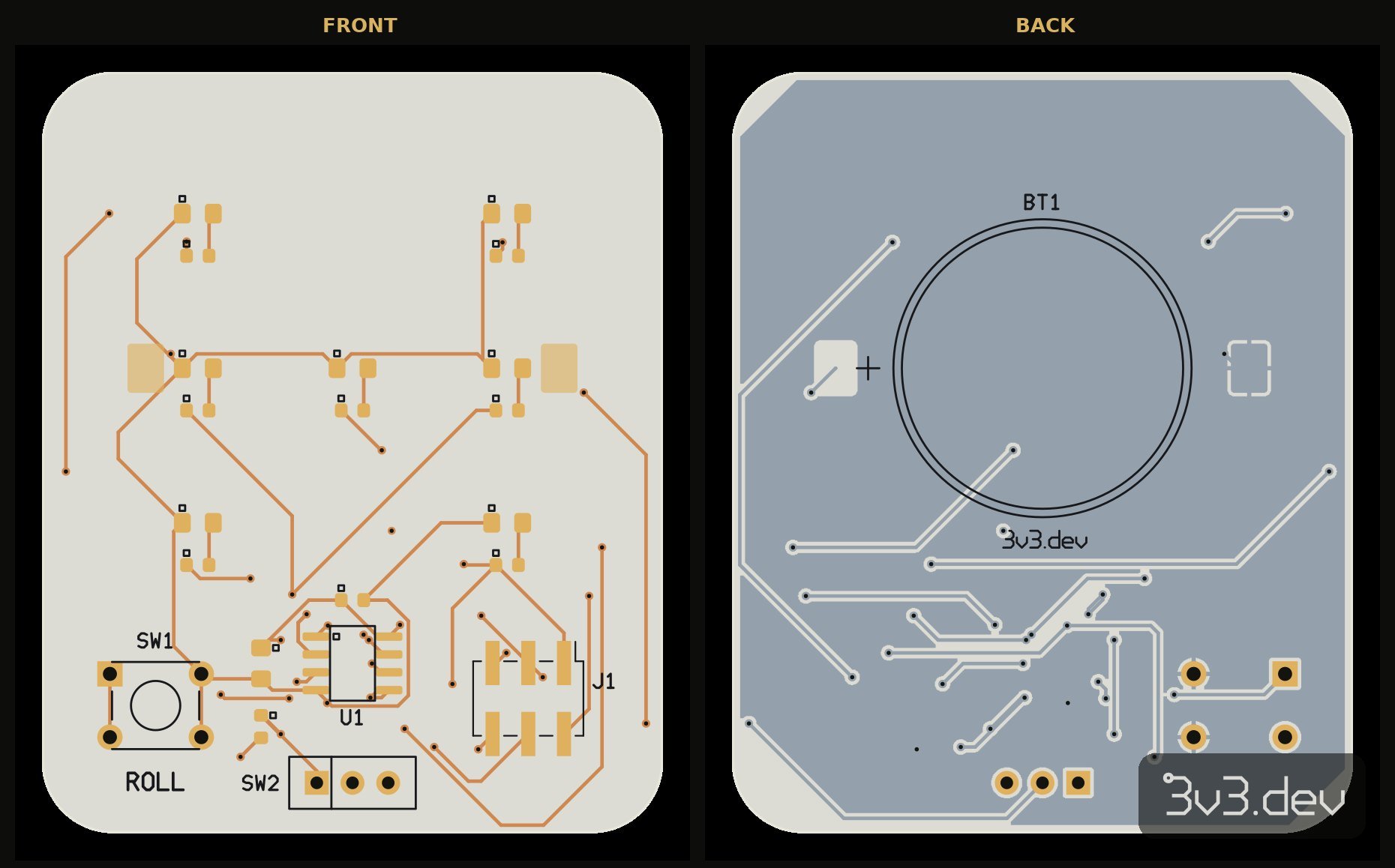
2. The kindness
A fair die forgets. This one remembers your last three rolls, and if all three were a 1 or a 2, it gives you a six one time in three. Otherwise it is an ordinary die. The program has not been compiled or run on the board; the rule is all in one line, so make it as kind or as cruel as your family can bear. The pips go dark five seconds after each roll to save the coin cell, and the slide switch turns it fully off.
// The Sympathy Die (ATtiny85). An untested sketch.
// Pip groups: PB0 centre, PB1 one diagonal, PB2 the other diagonal, PB3 the middle pair. PB4 is the ROLL button.
const byte face[] = {0b0001, 0b0010, 0b0011, 0b0110, 0b0111, 0b1110};   // 1 to 6
int last[3] = {6, 6, 6};
unsigned long shown = 0;      // when the result went up; 0 = dark

void show(int n) { for (int b = 0; b < 4; b++) digitalWrite(b, (face[n - 1] >> b) & 1); }
void show0() { for (int b = 0; b < 4; b++) digitalWrite(b, LOW); }

void setup() {
  for (int b = 0; b < 4; b++) pinMode(b, OUTPUT);
  pinMode(4, INPUT_PULLUP);
}

void loop() {
  if (shown && millis() - shown > 5000) { show0(); shown = 0; }   // dark after five seconds
  if (digitalRead(4) == LOW) {
    randomSeed(micros());                       // how long you waited is the randomness
    for (int i = 0; i < 10; i++) { show(random(1, 7)); delay(40 + i * 15); }   // the tumble
    int roll = random(1, 7);
    bool unlucky = last[0] <= 2 && last[1] <= 2 && last[2] <= 2;           // three bad rolls running
    if (unlucky && random(3) == 0) roll = 6;    // one time in three, a quiet six
    last[0] = last[1]; last[1] = last[2]; last[2] = roll;
    show(roll);
    shown = millis();
    while (digitalRead(4) == LOW) {}
    delay(50);
  }
}
Do not use it for anything with money on the table.
3. In 3D
Prompt
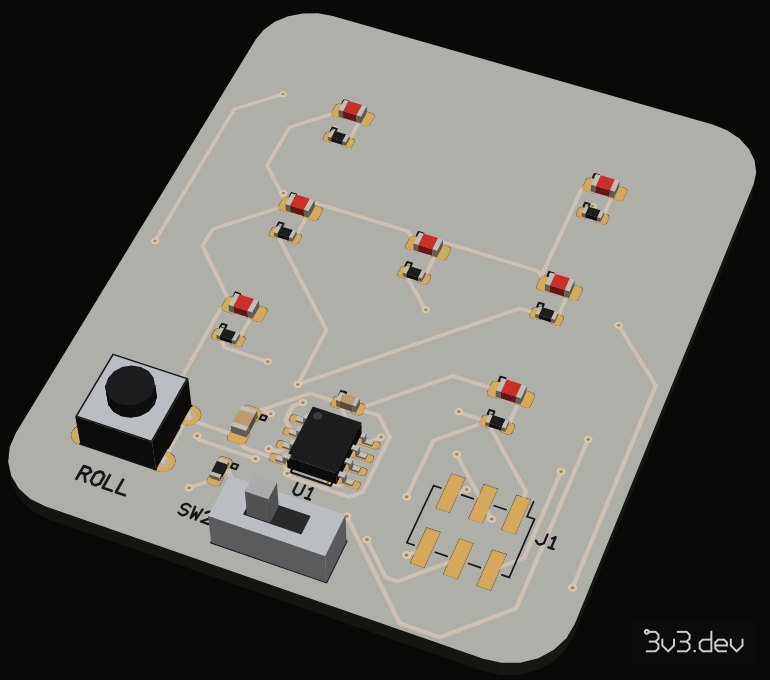
Show me the front in 3D.
Why it is written this way
Seven pips, one button. Nothing on the front gives away that it cares.
Output
the 3D view
The front in 3D.
Make it yourself
The board is open hardware under CERN-OHL-P: open it on 3v3.dev, copy it, change it, make it.

The Gerber files are ready for any fab:
Your agent can build boards like this too. Connect it and start free: 20 boards a month, up to 4 layers, no card.